
TL;DR
The scale cannot tell you what you lost. Rapid weight loss usually includes a meaningful amount of muscle, which lowers your metabolic rate and makes regain easier. Fat loss is slower on the scale but changes how you look and feel far more. Judge progress by measurements, strength numbers and how clothes fit, not by a single number each morning.
Almost everyone searching for help in Singapore uses the phrase weight loss. What almost everyone actually wants is fat loss. They are not the same thing, and confusing them is the reason a lot of people end up lighter but no happier with how they look.
This post covers what the difference actually is, how to tell which one is happening to you, and what changes about your training once you understand it.

What the scale actually measures
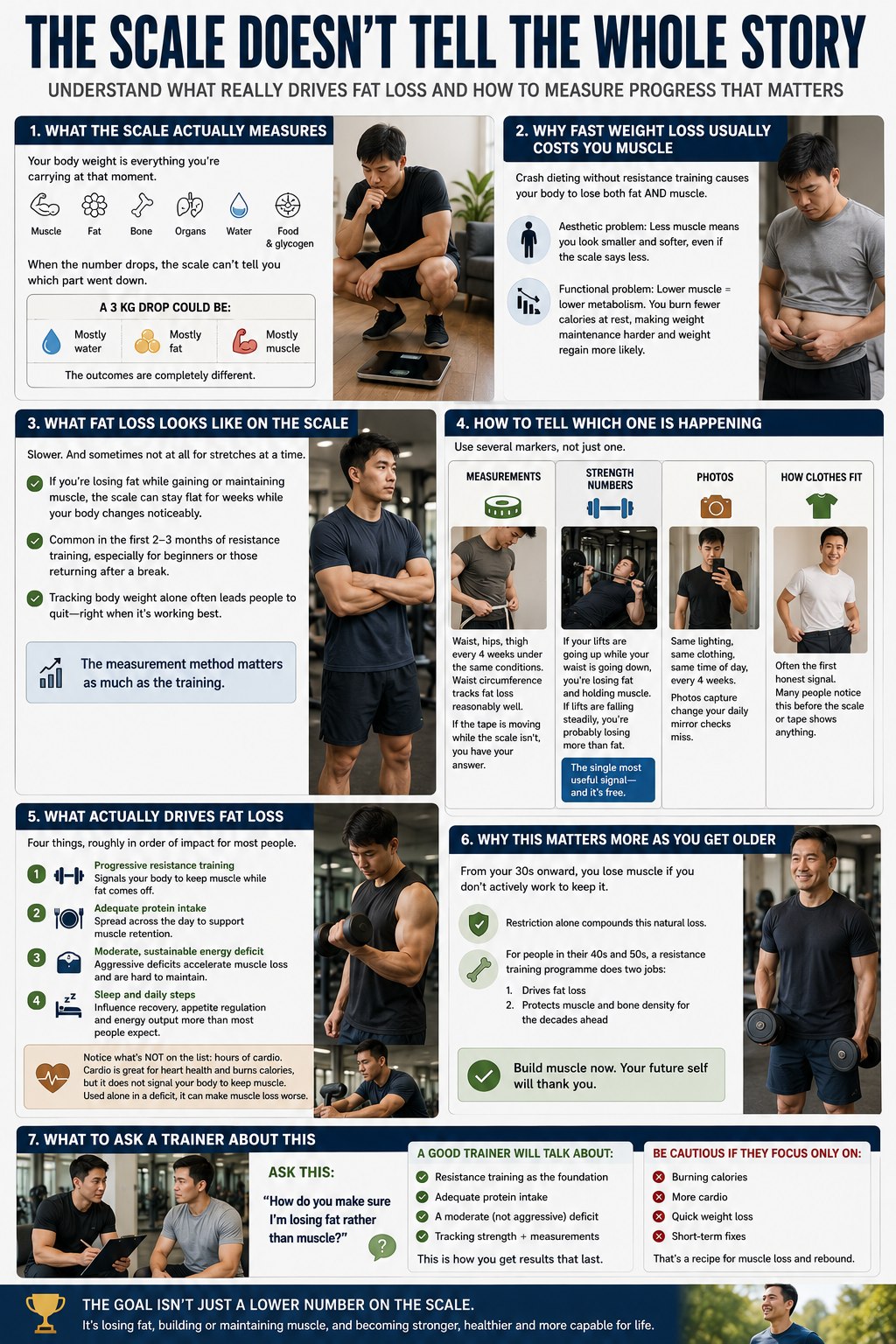
Your body weight is the total of everything you are carrying at that moment. Muscle, fat, bone, organs, the water in your tissues, the food in your digestive system and the glycogen stored in your muscles and liver.
When that number drops, the scale has no way of telling you which part went down. That is the entire problem. A three kilogram drop could be mostly water, mostly fat, mostly muscle, or some combination, and the outcomes of those three scenarios are completely different.
Why fast weight loss usually costs you muscle
When intake drops sharply and there is no resistance training in place, the body draws on both fat and muscle tissue. Muscle is metabolically expensive to maintain, so under significant restriction the body is fairly willing to give some of it up.
This creates two problems. The first is aesthetic. Muscle is what gives the body its shape, so losing it alongside fat leaves you smaller but softer, which is rarely what people had in mind. Many people reach their target weight and feel disappointed by the result.
The second problem is functional. Less muscle means a lower resting metabolic rate, so you burn fewer calories at rest than you did before. That makes maintaining the new weight harder than maintaining the old one, and it is a significant part of why weight regain is so common.
What fat loss looks like on the scale
Slower, and sometimes not at all for stretches at a time.
If you are losing fat while gaining or maintaining muscle, the scale can stay flat for weeks while your body changes noticeably. This is common in the first two to three months of resistance training, particularly for people who are new to it or returning after a long break.
People who only track body weight during this period frequently conclude the programme is not working and stop, at exactly the point where it is working best. That is why the measurement method matters as much as the training.
How to tell which one is happening
Use several markers rather than one.
Measurements
Waist, hips and thigh, taken every four weeks under the same conditions. Waist circumference in particular tracks fat loss reasonably well. If the tape is moving while the scale is not, you have your answer.
Strength numbers
If your lifts are going up while your waist is going down, you are almost certainly losing fat and holding muscle. If your lifts are falling steadily, you are probably losing more than fat. This is the single most useful signal available and it costs nothing to track.
Photos
Same lighting, same clothing, same time of day, every four weeks. Photos capture change that daily mirror checks miss entirely, because you see yourself too often to notice gradual change.
How clothes fit
Often the first honest signal, and frequently reported before either the scale or the tape shows anything meaningful.
What actually drives fat loss specifically
Four things, roughly in order of impact for most people.
- Progressive resistance training, which provides the reason for your body to hold onto muscle while fat comes off
- Adequate protein intake spread across the day, which supports the same outcome
- A moderate, sustainable energy deficit rather than an aggressive one, since aggressive deficits accelerate muscle loss
- Sleep and daily step count, both of which influence recovery, appetite regulation and energy output more than most people expect
Notice that hours of cardio does not appear on that list. Cardio is useful for cardiovascular health and adds to daily energy output, but it does nothing to signal your body to keep muscle. Used on its own in a deficit, it can make the muscle loss problem worse.
Why this matters more as you get older
Adults gradually lose muscle mass from around their thirties onward if they do nothing to counter it. Anyone approaching fat loss through restriction alone is compounding a process that is already running in the background.
For clients in their forties and fifties in particular, a programme built on resistance training does two jobs at once. It drives the fat loss they came for, and it protects the muscle and bone density that matter considerably more over the following decades.
What to ask a trainer about this
A useful screening question is simply: how do you make sure I am losing fat rather than muscle?
A good trainer will talk about resistance training being the foundation, protein intake, a moderate rather than aggressive deficit, and tracking strength alongside measurements. A trainer who responds by talking only about burning calories or increasing cardio has told you what their programme is going to look like.
Frequently Asked Question
Yes, particularly if you are new to resistance training, returning after a long break, or carrying a higher level of body fat. This is why the scale often stays flat in the early months while measurements and photos change noticeably. For well trained individuals the two goals become harder to pursue simultaneously and are usually phased instead.
Plateaus on the scale are normal and often do not mean fat loss has stopped. Water retention, glycogen storage, digestive contents and hormonal fluctuation can mask several weeks of genuine progress. Check your measurements and strength numbers before changing anything. If those are also flat for three to four weeks, the programme needs adjusting.
It can be useful as a trend, but most consumer methods including bioelectrical impedance scales have a wide margin of error and are heavily affected by hydration. If you use one, take readings under identical conditions and pay attention to the direction of travel over months rather than the specific number on any given day.
Want a programme built to keep muscle while the fat comes off? Rodandac trainers work at your home or condo gym across Singapore. Message us on WhatsApp for a free 60 minute trial session and a proper starting assessment.
Comments +