
TL;DR
Get medical clearance first, usually at the six week check, though timelines vary and a caesarean birth often needs longer. Start with breathing, core and pelvic floor work before loading. Progress to full strength training over several months. Training at home removes the childcare problem, which is the main reason postnatal programmes stall.
Returning to exercise after having a baby involves more uncertainty than most fitness content acknowledges. Advice ranges from doing nothing for months to bouncing back in six weeks, and neither is a useful starting point.
This guide covers what postnatal personal training involves in Singapore, when it is generally appropriate to begin, what a sensible programme looks like, and what to look for in a trainer.
One note before anything else: this is general information, not medical advice. Your doctor or a women’s health physiotherapist knows your specific situation and should be the first person you speak to.
When to start
The standard reference point in Singapore is the six week postnatal check, where your doctor assesses recovery and advises on returning to activity. That is a starting point for the conversation rather than a universal green light.
Several things affect the timeline. A caesarean birth is major abdominal surgery and generally requires a longer recovery before loaded training begins, often closer to ten to twelve weeks. A difficult delivery, significant tearing, or ongoing symptoms may extend it further.
Gentle walking and breathing work can usually begin well before six weeks, often within days, provided you feel up to it and your doctor has not advised otherwise. Structured resistance training waits for clearance.
If you have symptoms such as leaking urine, a feeling of heaviness or pressure in the pelvis, or persistent abdominal separation, ask for a referral to a women’s health physiotherapist before starting a training programme. These are common and treatable, and they are worth addressing properly rather than training through.
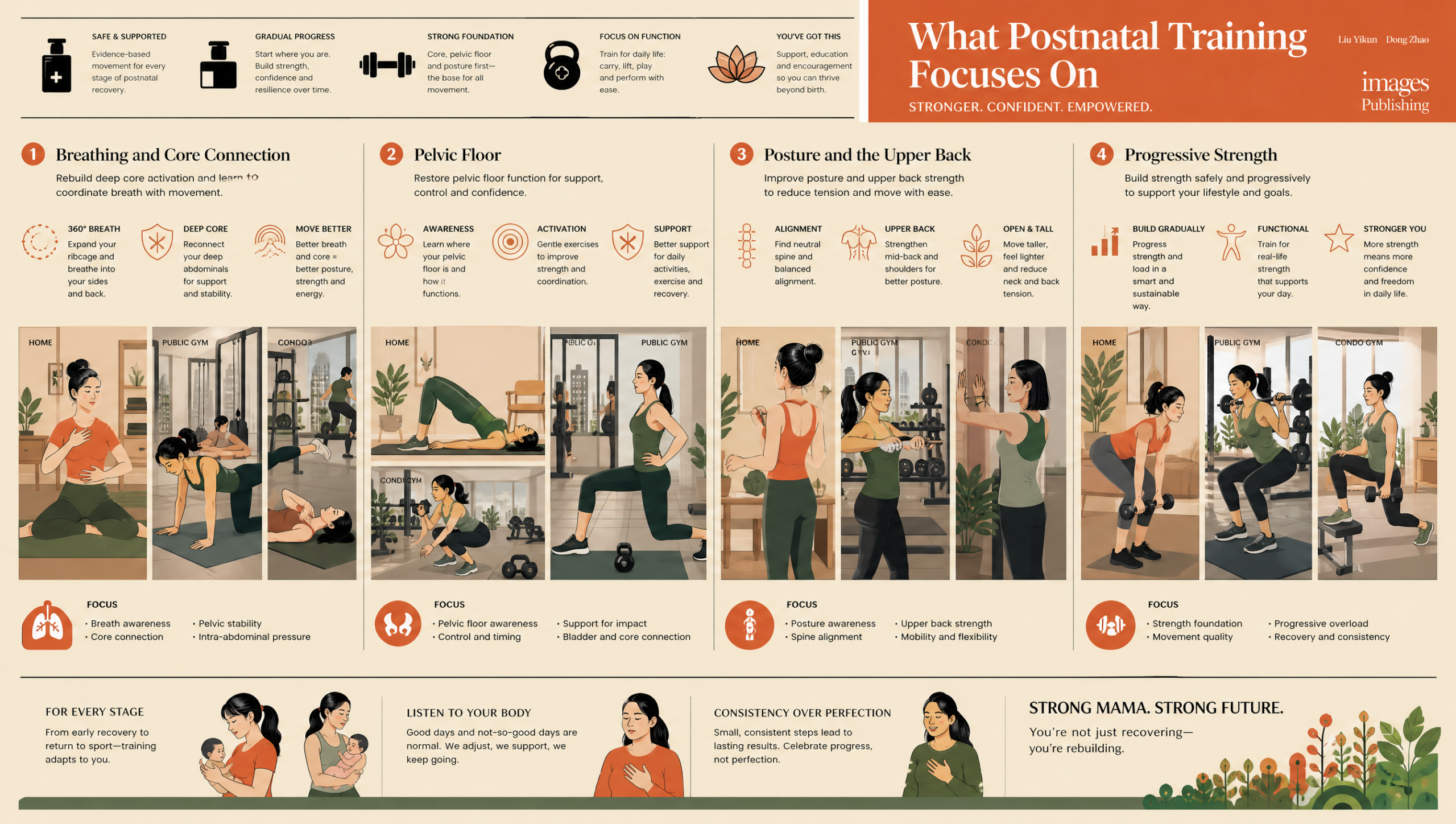
What postnatal training focuses on

A good postnatal programme is built in a specific order. Skipping ahead is the most common cause of setbacks.
Breathing and core connection
The first phase reconnects your diaphragm, deep core and pelvic floor, which function as a coordinated system that pregnancy disrupts. This looks unimpressive and feels easy, and it is the foundation everything else sits on. Rushing past it is why some women find core work uncomfortable months later.
Pelvic floor
Pelvic floor training is not simply doing kegels. It involves both contracting and fully relaxing, coordinated with breathing and eventually with movement under load. A trainer with postnatal qualification will programme this properly. If you have symptoms, a women’s health physiotherapist should assess you first.
Posture and the upper back
Months of feeding, carrying and pushing a pram place real strain on the neck, shoulders and upper back. Most postnatal clients arrive with tight chest muscles and a weak upper back. Addressing this early tends to produce the fastest noticeable relief.
Progressive strength
Once the foundations are in place, the programme moves toward proper strength work. This matters more than most new mothers are told. Carrying a growing child, lifting a pram in and out of a car boot and getting up off the floor repeatedly are strength demands. Training for them makes daily life easier.
What about abdominal separation?
Some degree of abdominal separation, known as diastasis recti, is normal during pregnancy and present in most women immediately after birth. It often resolves substantially on its own over the first few months.
Where it persists, it responds well to appropriate progressive loading rather than avoidance. What is generally advised against in the early phase is aggressive flexion work such as sit ups and crunches, and any movement that causes visible doming along the midline. A qualified trainer will screen for this and programme around it. A physiotherapist can assess it properly.
Why home training suits this stage
The practical barrier to postnatal training is rarely motivation. It is logistics.
Getting to a gym with a newborn requires either childcare or a partner available at a fixed time twice a week, and both are difficult to guarantee. A trainer who comes to your home removes the problem entirely. The session happens during a nap, or with the baby in the room, and neither is unusual.
It also means you are not navigating a crowded gym floor in a body that may still feel unfamiliar, which matters more to many women than they expect.
What to look for in a postnatal trainer
- A specific prenatal and postnatal certification, not just general personal training qualification
- A willingness to ask about your birth, your recovery and any ongoing symptoms before writing anything
- Awareness of when to refer you to a women’s health physiotherapist rather than proceeding
- A programme that starts with breathing and core work rather than jumping to loaded training
- Realistic language about timelines, and no talk of bouncing back
A realistic timeline
Roughly speaking, expect the first four to six weeks after clearance to focus on breathing, core reconnection, posture and light full body movement. The following two to three months build progressive strength across the main movement patterns. From around month six onward, most women are training much like anyone else, with attention to pelvic floor as loads increase.
Sleep is the wildcard. Progress with a baby who sleeps through differs considerably from progress with one who does not, and a good trainer adjusts accordingly rather than holding you to a fixed schedule.
Frequently Asked Questions
Gentle walking and breathing work can usually begin early, often within days, if you feel able and your doctor has not advised otherwise. Structured resistance training generally waits for clearance at your six week postnatal check. After a caesarean birth the timeline is typically longer, often ten to twelve weeks. Your doctor should confirm what is appropriate for your recovery.
In most cases yes, with appropriate programming. Persistent abdominal separation generally responds better to progressive, controlled loading than to avoiding training. What is usually avoided early on is aggressive flexion work such as sit ups, and any movement causing visible doming along the midline. A women’s health physiotherapist can assess the separation properly and guide what is suitable.
With home based training, yes, and it is common. Sessions often run during a nap, or with the baby nearby. A trainer experienced with postnatal clients expects interruptions and works around them. This is one of the main reasons mothers choose home training over a gym at this stage.
Rodandac has certified female trainers with prenatal and postnatal qualifications who come to your home across Singapore. Message us on WhatsApp to talk through your recovery and book a free 60 minute trial session when you are ready.
Comments +