

TL;DR
A good weight loss trainer builds strength alongside fat loss, gives you habits you can keep, and tracks more than the scale. Be cautious of anyone promising a fixed number of kilos by a fixed date, selling supplements, or putting you on a severe restriction. Ask about their approach before you ask about their price.
Searching for a weight loss personal trainer in Singapore returns a lot of confident claims and very little useful information about how any of them actually work.
This guide covers what a good trainer should be doing, the questions worth asking before you book, the warning signs to walk away from, and what realistic progress looks like over three to six months.
What a weight loss trainer should actually do
The job is not simply to make you tired. Anyone can write a session that leaves you on the floor. The job is to change your body composition in a way that holds, which requires several things happening at once.
Build strength while you lose fat
This is the part cheap programmes skip. Losing weight without resistance training means losing muscle alongside fat, which lowers your metabolic rate and makes the weight easier to regain. A well built programme is centred on progressive resistance work, not endless circuits.
Give you habits rather than rules
A trainer who hands you a rigid meal plan has solved the problem for twelve weeks and created a new one afterwards. What you want is guidance you can apply at a hawker centre, at a work dinner and on holiday. That is what makes results last past the end of the package.
Track more than body weight
Scale weight moves for many reasons that have nothing to do with fat loss, including water balance, sodium, sleep and where you are in your cycle. A good trainer tracks measurements, progress photos, strength numbers, energy levels and how your clothes fit. The scale is one input among several.
Adjust based on data
Your programme in week twelve should not look like your programme in week one. Progress stalls are normal and expected. The trainer’s job is to notice them early and change something deliberately rather than telling you to try harder.
Five questions to ask before you book
Ask these on the first call or during the trial session. The answers tell you a great deal.
- How do you structure a fat loss programme, and how much of it is resistance training versus cardio? You want resistance training to be the backbone.
- How do you handle nutrition, and are you qualified to advise on it? Look for practical guidance and honesty about the limits of their scope.
- How do you track progress? If the only answer is body weight, keep looking.
- What happens when progress stalls? A specific answer signals experience. A vague one signals a template.
- Can you describe a client with a similar starting point to mine and how it went? Detail here is hard to fake.
Red flags worth walking away from
- Guaranteeing a specific number of kilos by a specific date. Nobody can promise this honestly, because individual response varies too much.
- Selling supplements, meal replacements or fat burners as a core part of the programme. This is a revenue stream, not a training method.
- Pushing severe food restriction or very low intake. This produces fast early numbers and poor long term outcomes, and it is outside a trainer’s scope of practice.
- Refusing to explain why the programme is built the way it is. You should understand what you are doing and why.
- Applying pressure to buy a large package before you have trained with them once.
- No initial assessment. Any programme written before someone has seen you move is a template.
What realistic progress looks like
Setting expectations properly is one of the most useful things a trainer does, so here is a fair picture.
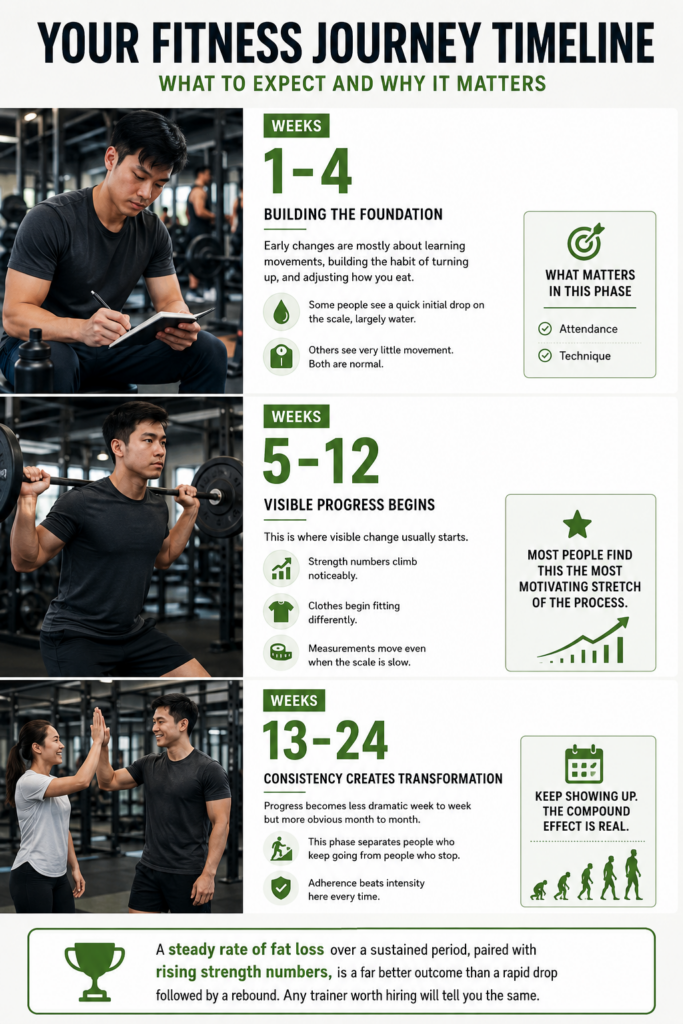
Weeks 1 to 4
Early changes are mostly about learning movements, building the habit of turning up, and adjusting how you eat. Some people see a quick initial drop on the scale, largely water. Others see very little movement. Both are normal. What matters in this phase is attendance and technique.
Weeks 5 to 12
This is where visible change usually starts. Strength numbers climb noticeably, clothes begin fitting differently, and measurements move even when the scale is slow. Most people find this the most motivating stretch of the process.
Weeks 13 to 24
Progress becomes less dramatic week to week but more obvious month to month. This phase separates people who keep going from people who stop. Adherence beats intensity here every time.
A steady rate of fat loss over a sustained period, paired with rising strength numbers, is a far better outcome than a rapid drop followed by a rebound. Any trainer worth hiring will tell you the same.
Why training at home helps consistency
Weight loss is a long game, and long games are won by turning up. The most common reason a programme fails in Singapore is not a bad plan. It is a plan that stopped being convenient sometime around week six.
Removing the commute removes the most common excuse. Training at home or in your condominium gym means the session happens at 6.30am before work or at 8pm after the children are asleep, without the surrounding hour of travel that would otherwise make it impossible.
How to start your weight loss journey?
Book a trial session with one or two trainers before committing to anything. Pay attention to whether they assess you properly, whether they explain their reasoning, and whether you would be comfortable being coached by this person twice a week for six months.
The trainer you will still be training with in month six matters far more than the one who runs the most impressive first session.
Frequently Asked Questions
Most people notice changes in strength and energy within three to four weeks, and visible changes in body composition between weeks six and twelve. The exact timeline depends on your starting point, how consistently you train, and your habits between sessions. Steady progress over several months holds far better than rapid early loss.
Both have a place, but resistance training should be the foundation. Building and keeping muscle while losing fat protects your metabolic rate and changes your body shape in a way that cardio alone does not. Cardio is a useful addition for overall health and energy output. A good trainer will programme both in the right proportion for you.
No, and a trainer who insists on severe restriction is worth avoiding. What works better is practical guidance you can apply to how you actually eat in Singapore, including hawker meals and social occasions. If you have specific medical or dietary needs, a trainer should refer you to a qualified dietitian rather than working outside their scope.
Ready to start? Rodandac trainers build fat loss programmes around resistance training, realistic habits and your actual schedule. Message us on WhatsApp for a 60 minute trial session at your home or condo gym.
Comments +