
TL;DR
Preferring a female trainer is a practical decision, not a preference you need to justify. Look for relevant certification, experience with your specific goal, and someone who assesses you properly before writing anything. Training at home removes the gym floor entirely, which is why many women in Singapore choose it.
A large share of women searching for a personal trainer in Singapore specifically want a female one. That preference gets treated as a footnote on most gym websites, usually a line saying female trainers are available on request.
It deserves a better answer than that. This guide covers why the preference is reasonable, what to actually look for, the questions worth asking, and how home based training changes the equation for women in Singapore.
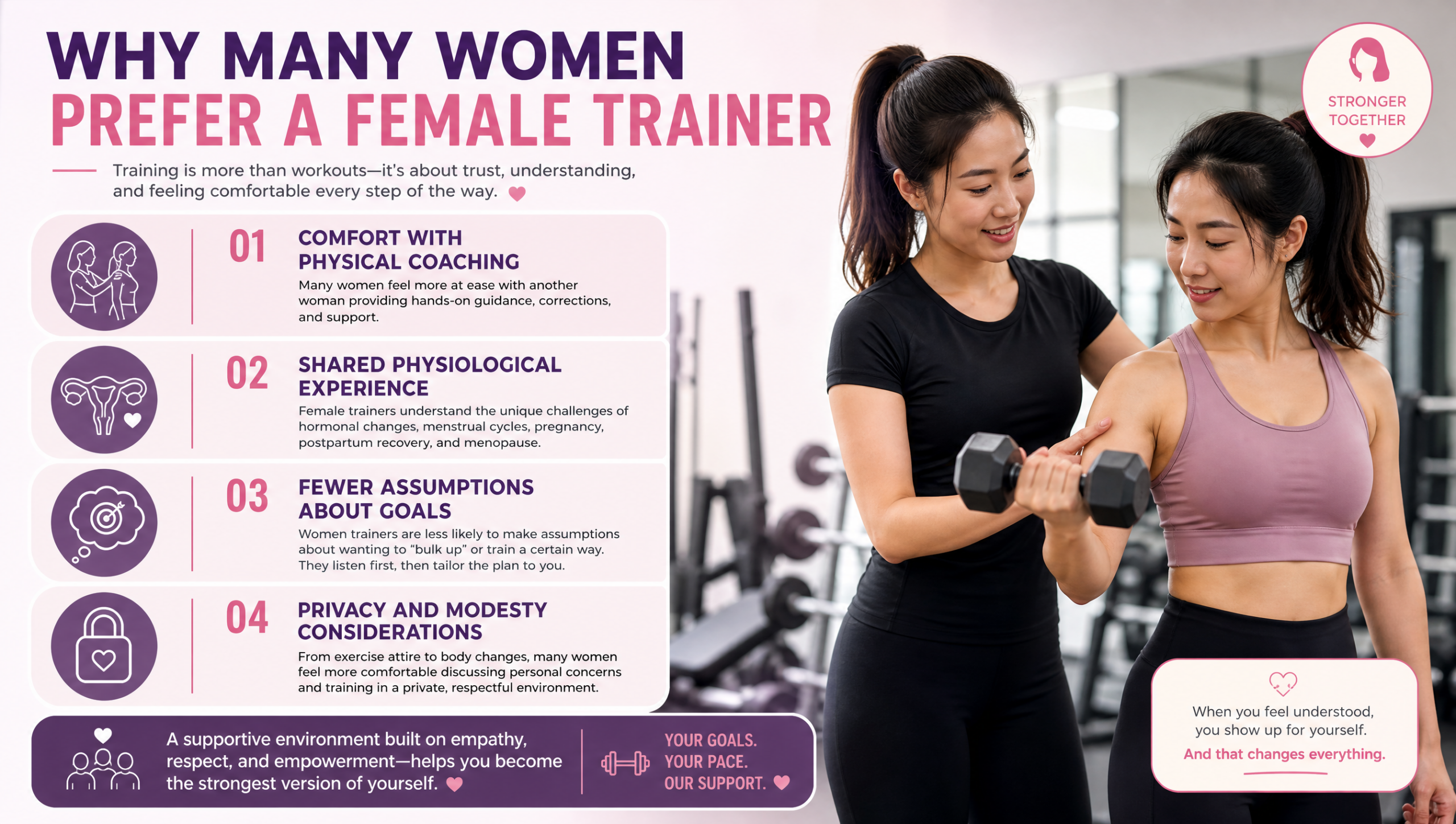
Why many women prefer a female trainer
There are several reasons, and none of them require justification.
Comfort with physical coaching
Personal training involves hands on cueing. A trainer may adjust your hip position in a deadlift or correct your shoulder placement in a press. Many women are simply more comfortable receiving that from another woman, particularly in the first few months while trust is being built.
Shared physiological experience
A female trainer has direct experience of training through a menstrual cycle, and often through pregnancy and postpartum recovery. She understands why energy and strength fluctuate across a month, and can programme around it rather than treating a bad week as a motivation problem.
Fewer assumptions about goals
Women are still routinely steered toward light weights and long cardio sessions, on the outdated assumption that lifting heavy produces a bulky physique. Female trainers who lift themselves are generally quicker to programme proper progressive strength work, which is what actually changes body composition.
Privacy and modesty considerations
For some clients this is a religious or cultural requirement rather than a preference. A female trainer working in your home makes training genuinely possible where a mixed commercial gym would not.
What to look for in a female personal trainer
Certification that is current and recognised
Look for internationally recognised certification such as ACE, ISSA, NASM or NCSF, plus current CPR, AED and first aid certification. Ask when it was last renewed. Certification that lapsed four years ago tells you something about how seriously the trainer takes their own standards.
Experience with your specific goal
General fitness experience is not the same as experience with your situation. If you are returning after giving birth, you want someone with a postnatal qualification. If you are managing a knee issue, you want someone who has worked around one before. Ask directly.
A proper assessment before any programme is written
Any trainer who provides a programme before watching you move is handing you a template. A real assessment covers training history, injuries, how you sleep, your schedule, and a look at basic movement patterns such as a squat, a hinge and an overhead reach.
Clear communication about progression
You should understand what you are doing and why. A good trainer explains the reasoning, tracks your numbers between sessions, and can tell you exactly how this month’s programme differs from last month’s and what prompted the change.
Questions worth asking before you book
- What is your certification and when did you last renew it?
- Have you worked with clients at a similar starting point to mine, and how did those go?
- How do you structure a programme, and how often does it change?
- How do you track progress beyond body weight?
- How do you handle training around the menstrual cycle, if that is relevant to me?
- What happens if I need to cancel or reschedule a session?
The quality of the answers matters more than the content. Specific, detailed responses signal experience. Vague reassurance signals a script.
Where women train in Singapore
The three realistic options each suit different situations.
Commercial gyms
Full equipment range, but the free weights area is frequently crowded and male dominated, which is exactly the environment many women are trying to avoid. Membership costs sit on top of session fees.
Women only gyms
A comfortable environment, though equipment ranges are often lighter and locations are limited. Worth considering if a dedicated space away from home suits you.
Home and condominium gym training
The trainer comes to you. No gym floor, no audience, no commute. For mothers with young children this is frequently the only workable option, since the session happens while the children are at home rather than requiring childcare. It is also the reason many women who had given up on training start again.
On lifting heavy
It is worth addressing directly, because it still puts women off strength training. Progressive resistance training does not produce a bulky physique in women. The hormonal profile that drives that kind of muscle gain is not present at the same levels.
What resistance training does produce is greater strength, better bone density, improved body composition, and the shape most women describe when they say toned. The training that produces that outcome is the same training that produces strength. There is no separate toning programme.
How to start
Book a trial session with one or two trainers before committing to a package. Notice whether she assesses you properly, whether she explains her reasoning, and whether you feel comfortable. That comfort is not a small factor. It largely determines whether you are still training in month six.
If a trainer cannot offer a trial, or pushes for a large package upfront, that tells you what you need to know.
Frequently Asked Questions
Yes. Mobile personal training is well established in Singapore and a number of providers have certified female trainers who travel to clients. Sessions run at your home, your condominium gym or a nearby park. This suits women who prefer not to train in a commercial gym, and mothers who cannot easily leave the house.
No. Building large amounts of muscle requires a hormonal profile, a training volume and a caloric surplus that most women are not working with. Progressive resistance training in women improves strength, bone density and body composition, which is what produces the lean, defined look most clients are describing when they ask about toning.
Many women find strength and energy vary across the month, and a trainer experienced in this will adjust intensity rather than expect a flat output every week. This does not mean stopping training. It means placing harder sessions where you tend to feel strongest and easing back where you do not. If you have symptoms that significantly disrupt training, it is worth raising with your doctor.
Rodandac has certified female trainers working across Singapore who come to your home or condo gym. Message us on WhatsApp, tell us your goals, and we will match you with the right trainer and arrange a 60 minute trial session.
Comments +