
TL;DR
Home training suits older adults better than a gym for most practical purposes: no transport, no heat, no audience, and balance work done in the actual environment where balance matters. A good programme covers strength, balance, mobility and cardiovascular fitness. Equipment needed is minimal, usually a sturdy chair, light dumbbells and resistance bands.
For older adults in Singapore, the barrier to training is rarely the training itself. It is everything around it: getting to the gym, the walk in the heat, feeling out of place among a much younger crowd.
Home based senior fitness removes most of that. This guide covers what a home programme should include, what equipment is needed, how to set the space up safely, and what a sensible week looks like.
Speak to your doctor before beginning any new exercise programme, particularly if you are managing an existing condition.
Why home training works well for older adults
The transport problem is the obvious one. A gym session in Singapore for someone in their seventies often means a taxi, a walk from the drop off point, and the same again afterwards. In the heat, that can be more tiring than the session.
There is a confidence factor too. Commercial gyms are loud, busy and populated largely by people forty years younger. Many older adults simply do not want to learn a new skill in that environment, and there is no reason they should have to.
The most useful advantage is specific. Balance training done at home happens in the environment where balance actually matters. A trainer working in your flat can address the particular step at your entrance, the height of your sofa, the layout of your bathroom. That is genuinely more useful than practising on gym equipment.
The four pillars of a senior fitness programme
1. Strength
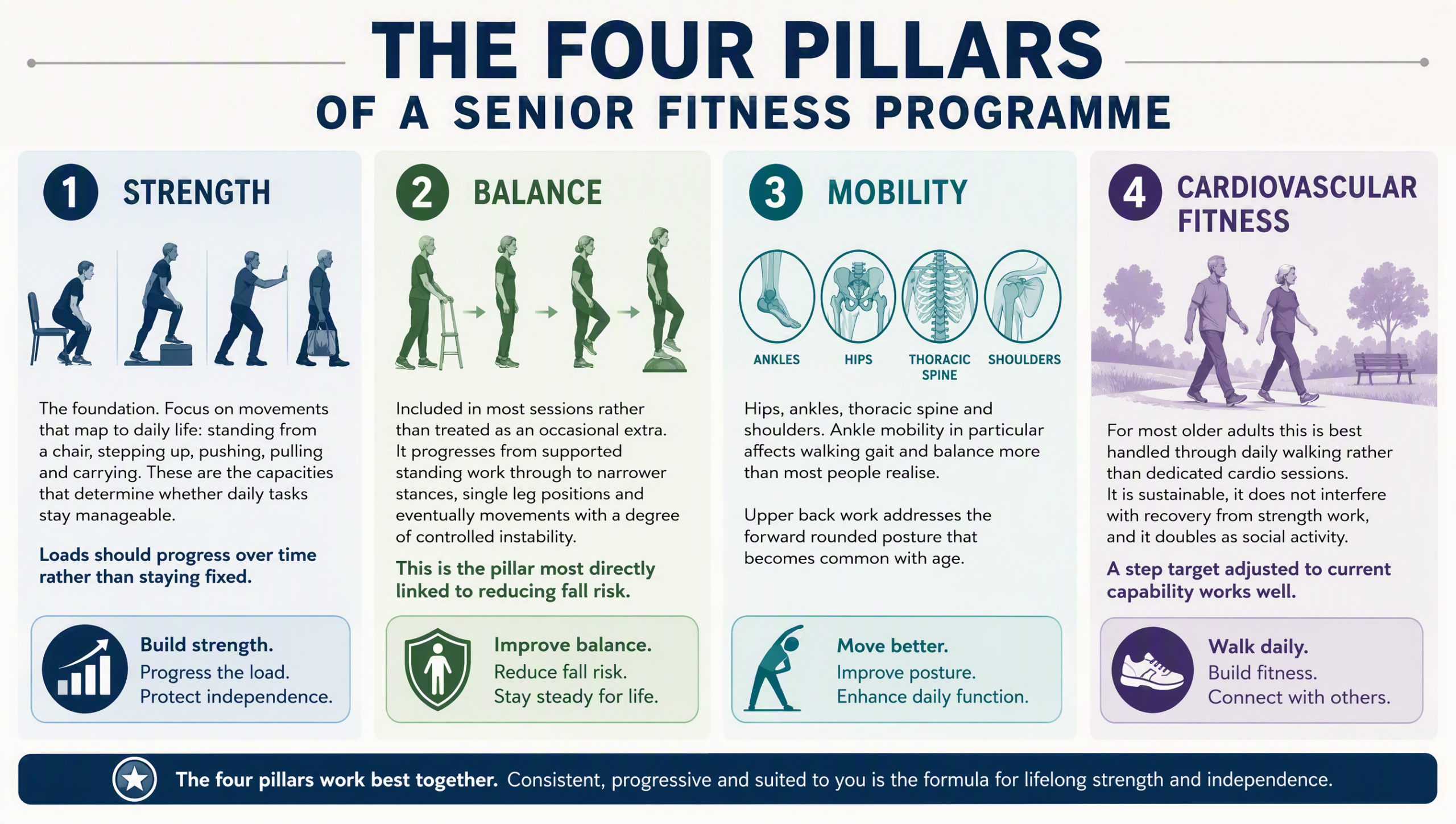
The foundation. Focus on movements that map to daily life: standing from a chair, stepping up, pushing, pulling and carrying. These are the capacities that determine whether daily tasks stay manageable. Loads should progress over time rather than staying fixed.
2. Balance
Included in most sessions rather than treated as an occasional extra. It progresses from supported standing work through to narrower stances, single leg positions and eventually movements with a degree of controlled instability. This is the pillar most directly linked to reducing fall risk.
3. Mobility
Hips, ankles, thoracic spine and shoulders. Ankle mobility in particular affects walking gait and balance more than most people realise. Upper back work addresses the forward rounded posture that becomes common with age.
4. Cardiovascular fitness
For most older adults this is best handled through daily walking rather than dedicated cardio sessions. It is sustainable, it does not interfere with recovery from strength work, and it doubles as social activity. A step target adjusted to current capability works well.
Equipment you actually need
A workable home setup is:
- A sturdy, stable chair without wheels, used for both sit to stand work and as balance support
- A set of light dumbbells, commonly 1kg to 5kg to start, with room to progress upward
- Resistance bands in two or three tensions
- A non slip mat for floor work
- A clear wall or stable surface within reach for balance exercises
- Roughly two metres by two metres of clear floor space
Most mobile/ home trainers bring dumbbells and bands to the session, so there is usually nothing to buy before starting. If your condominium has a gym, that equipment is used as well.
Setting the space up safely
- Clear loose rugs, cables and clutter from the training area before each session
- Make sure lighting is good, since visual input contributes significantly to balance
- Have a stable support within arm’s reach for any standing balance work
- Train in proper shoes with a firm sole, not slippers or bare feet on tile
- Keep water within reach and take breaks, particularly in warmer months
- Avoid training on wet or recently mopped floors
A sample week
For someone starting out, a reasonable week might look like:
- Two supervised sessions of 45 to 60 minutes, spaced with at least one day between them
- Daily walking, adjusted to current capability and built up gradually
- One short balance practice on a non training day, often five to ten minutes
- Rest days that are genuinely rest, since recovery drives the adaptation
Two supervised sessions a week produces meaningful strength and balance improvement for most people. Three is possible once a base is established, but consistency over months matters far more than frequency in any single week.
Training with a trainer versus training alone
Independent training is possible, and for someone with previous exercise experience it can work. For most people starting after 65, supervision is worth the cost for three reasons.
Technique gets corrected before it becomes a problem. Progression happens deliberately rather than plateauing at whatever felt comfortable in week two, which is the most common failure mode of independent senior training. And attendance is simply higher when someone is arriving at the door.
When to stop and see a doctor
Stop the session and seek medical advice for chest pain or pressure, unusual shortness of breath, dizziness or feeling faint, an irregular heartbeat, or sudden sharp joint pain. Ordinary muscle fatigue and mild soreness in the day or two after a session are normal and expected. Anything sharp, sudden or affecting your chest is not.
Frequently Asked Questions
Very little. A sturdy chair, light dumbbells, resistance bands and a non slip mat cover most programmes, along with around two metres square of clear floor space. Most trainers bring dumbbells and bands with them, so there is usually nothing to purchase before your first session.
Roughly two metres by two metres of clear floor is enough for most senior programmes, since the movements involved are not large. A living room with the coffee table moved aside is typically sufficient. If your condominium has a gym, that can be used instead or in addition.
Often yes, and training may improve your stability over time. The programme starts with more supported movements and progresses as balance improves. Your doctor or physiotherapist should confirm what is appropriate, and the trainer should know about the walking aid before the first session so the programme accounts for it.
Rodandac trainers work with older adults at home and in condominium gyms across Singapore. Message us on WhatsApp to talk through your situation, and we will arrange a 60 minute trial session in your own space.
Comments +